
National Hugging Day™ is celebrated every year on January 21 to encourage kindness, connection, and emotional well‑being. Founded in 1986 by Kevin Zaborney, the holiday now leads the worldwide Hug Challenge, introducing sensory‑friendly alternatives! National Hugging Day™ is trademarked.
Weltknuddeltag – Nationale Knuffeldag – Kramens Dag – Nacional Dia del Abrazo – Giornata Nazionale dell’Abbraccio – Journée nationale de Serrant (Câlin) – παγκόσμια ημέρα αγκαλιάς – Giornata nazionale dell’abbraccio – День объятий – „Международен ден на прегръдката“ – „Национален ден на прегръдката“ – ჩახუტების ნაციონალური დღე – राष्ट्रीय गले दिन 포옹(hug)하는날 or 안아주기하는날 – 全國擁抱日 राष्ट्रीय गले लगाने का दिवस
National Hugging Day™ (frequently shortened to Hug Day, National Hug Day, International or Global or World Hug Day), is a global social impact brand of National Hugging Day LLC. It was first widely celebrated in 1986 (40 Years!) after being published in “Chase’s Calendar of Annual Events.” Since that time, National Hugging Day™ has continued to grow internationally (USA, Canada, Brazil, Australia, UK and Ireland, Germany, Georgia, India, Sweden, Spain, Italy, France, Russia, South Africa, and 2023 promoted in Shanghai China as verified examples). National Hugging Day™ was created to encourage family and friends to hug more often (and consensually) with one another. Reasonable care should be taken with those who are either uncomfortable with public affection or their reaction to a hug is unknown. In those situations, it is advised to ask first before hugging and exchange consent. There is an abundance of past and current research available that finds positive touch, such as hugging, improves one’s physical, emotional and spiritual health. Embrace National Hugging Day™ every day!
Official announcement of the Most Huggable Person of 2026 is…
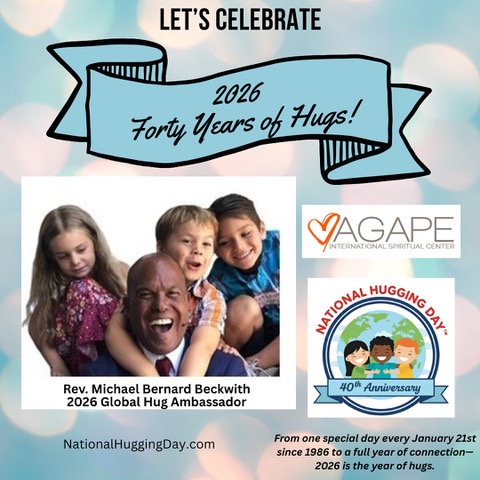
Rev. Dr. Michael B Beckwith of Agape Spiritual Center in Beverly Hills, California. He is the founder and spiritual director of Agape, which is a transdenominational community that aims to promote live, peace and positive influence. He is an active hugger and has grown to be a positive supporter of National Hugging Day!
The founder and creator of National Hugging Day™ and National Hugging Day LLC, is Kevin Zaborney, QIDP QMHP (sometimes called an “Ambassador of Hugs”). He earned a Bachelor of Arts degree in Psychology from the University of Michigan, and a Master of Divinity degree from Boston University. Kevin has been married to his wife for 32 years and resides in Caro, Michigan, USA. Kevin is available for personal appearances, speaking engagements and media interviews. Contact him at the “Contact Us” tab. Experience the excitement of National Hugging Day™!
Please support National Hugging Day with a one-time DONATION!
(Donations will help with costs associated with managing and promoting the global observance!)
Choose an amount
Or enter a custom amount
Your contribution is GREATLY APPRECIATED!
For 40 years, people around the world have used January 21 to share kindness, strengthen relationships, and support emotional health. The holiday has grown from a small idea in Michigan to a worldwide movement embraced by families, schools, workplaces, mental‑health advocates, and communities across more than 100 countries.
Hugging can:
- Reduce stress
- Boost oxytocin
- Improve mood
- Strengthen connection
- Support mental well‑being
When you consensually hug a friend, family member, coworker, or simply share a supportive gesture, you’re part of a worldwide kindness movement.
The Global Hug Challenge
This year’s celebration centers on the Hug Challenge — a worldwide invitation to share a hug, a kindness moment, or a sensory‑friendly alternative.
How to participate:
- Hug someone you care about
- Substitute a hug for a handshake
- Send a kindness note
- Offer a supportive affirmation
- Post your moment using #HugChallenge and #NationalHuggingDay to FACEBOOK
Everyone can participate — including those who prefer non‑touch forms of connection.
Autism-Friendly Ways to Participate
Not everyone enjoys physical touch, and that’s okay. National Hugging Day™ offers sensory‑friendly alternatives:
- Visual hugs
- Heart‑hand gestures
- Sensory plushies or stuffed animals
- Supportive scented messages
- Gentle high‑fives
- “I’m thinking of you” cards
These options allow autistic individuals, sensory‑sensitive people, and anyone who prefers non‑touch connection to join the celebration comfortably.
Copyright 1986-2026 National Hugging Day, LLC. National Hugging Day™ was established in 1986 then formally copyrighted in 1989 at the US Copyright Office under “National Hugging Day Collection.” The name, National Hugging Day™, is under Trademark. This does not limit the celebration of such a day or observance. It does, however, provide limited ownership and full credit of the name and observance to the creator and founder as well as negotiating rights of any profit from any sales or marketing using National Hugging (Hug) Day™. Photos on this site are the copyright of their respective owners. No infringement is intended. See WordPress privacy terms. National Hugging Day LLC only collects information provided by visitors through email, phone and the store.

